
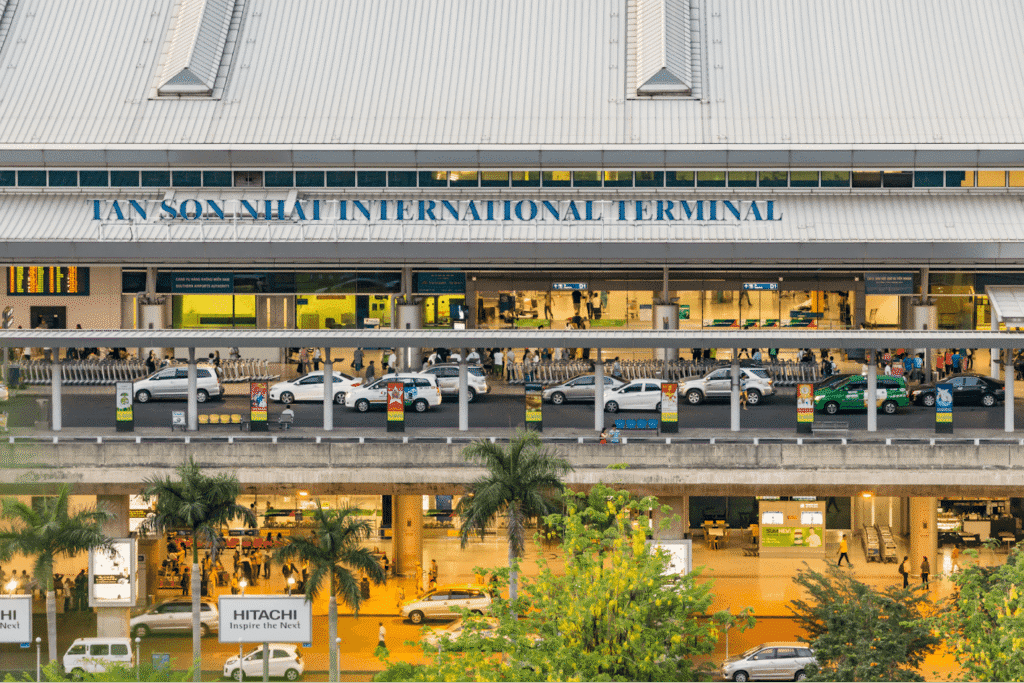
Tan Son Nhat International Airport (SGN) is the main airport serving Ho Chi Minh City. International passengers use Terminal 2, while domestic flights operate from Terminal 1 or Terminal 3 depending on the airline and route. Check the terminal shown on your ticket before traveling because domestic assignments can change.
This Tan Son Nhat Airport guide explains the terminal layout, international arrival process, immigration, SIM and eSIM options, transport into the city, terminal transfers and practical steps for a smoother first arrival in Vietnam.
Tan Son Nhat Airport at a Glance
| Airport detail | What travelers should know |
|---|---|
| Airport code | SGN |
| Location | Ho Chi Minh City, relatively close to the central districts |
| International terminal | Terminal 2 (T2) |
| Domestic terminals | Terminal 1 (T1) and Terminal 3 (T3), depending on the airline and route |
| Typical arrival order | Immigration → baggage claim → customs → public arrivals hall |
| Ways into the city | Ride-hailing app, metered taxi, private pickup or public bus |
The airport is geographically close to central Ho Chi Minh City, but road traffic can make the journey much longer than the distance suggests. Avoid arranging a tight appointment immediately after landing, especially if your flight arrives during a busy international arrival period or city rush hour.
Which Terminal Do You Need at Tan Son Nhat Airport?
Tan Son Nhat now has three passenger terminals. The most important rule is simple: international flights use T2, while domestic passengers must check whether their flight uses T1 or T3.
Terminal 1: Domestic flights
T1 continues to handle domestic services that are not assigned to T3. This includes flights operated by several domestic airlines and some regional routes. Do not assume that every domestic flight uses the same terminal.
Terminal 2: International flights
T2 handles international arrivals and departures. If you are flying into Vietnam from another country, this is where you normally complete immigration, collect checked baggage, pass through customs and enter the public arrivals hall.
Terminal 3: Domestic flights
T3 opened in April 2025 to increase domestic capacity. Most Vietnam Airlines domestic operations moved to T3 from 17 May 2025, although certain regional services and flights operated by other carriers may still use T1. Because operating assignments can change, the terminal printed on your booking or airline app should always take priority over a general airport guide.
Airports Corporation of Vietnam publishes operational updates for Tan Son Nhat Terminal 3 when major changes occur.
Can You Walk Between T1, T2 and T3?
T1 and T2 are next to each other and are the easiest terminals to transfer between. Follow the airport signs and allow extra time if you are carrying luggage.
T3 is in a separate terminal area and should not be treated as a quick walk from T2. The airport has operated a free shuttle between T1, T2 and T3, with published service hours from 04:30 to 00:30. Timetables and boarding points may change, so check the current signs or ask airport staff before leaving your terminal.
If you have separate international and domestic tickets, leave a generous connection buffer. You may need to clear immigration, collect baggage, pass through customs, change terminals and check in again. Follow the minimum connection time given by your airlines rather than relying on the scheduled landing time alone.
What Happens After an International Flight Lands at SGN?
International arrivals at Tan Son Nhat follow a straightforward process, but the total time varies according to your gate, immigration queue and baggage delivery.
- Follow the Arrivals and Immigration signs. Keep your passport and any required entry documents ready.
- Complete immigration. Join the appropriate passport-control line and wait until an officer calls you forward.
- Check your entry stamp or permitted stay. Confirm the details before walking away from the counter.
- Collect checked baggage. Check the screens for the carousel assigned to your flight.
- Pass through customs. Use the appropriate channel based on what you are carrying.
- Enter the public arrivals hall. From here, you can access SIM counters, transport services and your arranged meeting point.
Keep your baggage tag until you have left the controlled arrival area. If a bag does not arrive, report it to the airline or ground-handling desk before exiting baggage claim.
How Long Does Immigration Take at Tan Son Nhat Airport?
There is no reliable fixed waiting time. The immigration hall may move quickly during a quiet period and become crowded when several international flights land close together. Flight delays, holidays, staffing and the number of passengers requiring manual checks can all affect the queue.
If someone is meeting you, share your flight number rather than promising an exact exit time. Travelers with a driver, onward connection or time-sensitive appointment should build immigration and baggage collection into their schedule.
For a more focused explanation of queue patterns and preparation, read the Tan Son Nhat Airport immigration guide.
Baggage Claim and Customs at T2
After passport control, check the information screens and collect your bags from the assigned carousel. Baggage delivery can continue while passengers are still passing through immigration, so a long passport queue does not always mean an additional long wait at the carousel.
Customs comes after baggage claim. Use the green channel only when you have nothing that needs to be declared. Use the red channel or ask an officer when carrying goods, cash or restricted items that may exceed the applicable allowance. If you are unsure, review Vietnam’s current duty-free and declaration limits before traveling.
Do not pack medication, food, high-value goods or restricted equipment without checking the relevant Vietnamese entry rules. Customs and import requirements can change and are separate from airline baggage allowances.
Should You Buy a SIM Card at Tan Son Nhat Airport?
You can buy a tourist SIM after entering the public arrivals area at T2. This is useful if you want in-person installation assistance, but the available plans, prices and counter opening times may vary when you arrive.
Before paying, confirm:
- the mobile network and data allowance;
- the plan validity and activation time;
- whether the plan is data-only or includes a Vietnamese number;
- whether calls, SMS or hotspot use are supported;
- whether passport registration is required;
- that mobile data works before you leave the counter.
An eSIM is the more convenient option when you want your connection prepared before landing. GoVnSIM offers Vietnam eSIM plans using local networks, with data-only and phone-number options. The QR code and setup instructions are delivered by email, but activation rules vary by plan, so follow the instructions supplied with your order.
Use the Vietnam airport SIM card guide for a detailed airport-versus-online comparison, or compare current Vietnam eSIM plans before your flight.
How to Get from Tan Son Nhat Airport to Ho Chi Minh City
The right transport option depends on your arrival time, luggage, destination and whether you already have mobile data.
| Option | Best for | Important point |
|---|---|---|
| Grab or another ride-hailing app | Travelers who want an upfront app fare | Follow the live pickup pin and airport signs; drivers may not collect passengers directly from the main curb |
| Official metered taxi | Travelers without mobile data or an app account | Use the official taxi queue and avoid unsolicited drivers |
| Private airport pickup | Families, groups, late arrivals and travelers wanting a confirmed driver | Confirm the meeting point, flight number and waiting policy before arrival |
| Public bus | Budget travelers with manageable luggage | Routes and operating times can change; check the airport information desk or current transit app |
Using Grab or another ride-hailing app
Ride-hailing is convenient when your phone is already connected. Enter your exact hotel address, wait until a driver is confirmed and compare the license plate with the vehicle before getting in.
Pickup arrangements can change as the airport adjusts traffic lanes. Follow the location shown inside the app and the current ride-hailing signs instead of waiting wherever you exit the terminal. Ignore anyone who claims to be your driver when the vehicle or plate does not match the booking.
Taking an official taxi
Follow the signs to the official taxi desk or managed taxi queue. Do not accept a ride from someone approaching you inside the arrivals hall or near the exit. Confirm that the meter is running or that the fare terms are clear before departure, and keep your hotel address available in writing.
Booking a private airport pickup
A pre-arranged pickup is useful when you arrive late, travel with children, carry several bags or prefer not to find a vehicle after a long flight. Send the operator your correct flight number so the driver can monitor delays, and save the meeting instructions before takeoff.
GoVnSIM and Heera Travel provide private airport pickup in Ho Chi Minh City, with vehicle options for different group sizes and local support if the flight schedule changes.
Using a public bus
Public buses are normally the lowest-cost option, but they are less convenient with large luggage or after a late flight. Check the current route, last departure and walking distance from the final stop to your accommodation before boarding. Do not rely on an old route number or timetable saved from a previous trip.
What Should You Prepare for a Late-Night Arrival?
A late arrival is easier when the essential decisions are made before the flight:
- save your hotel address in English and Vietnamese;
- install your eSIM or save the airport Wi-Fi instructions;
- register your ride-hailing account before traveling;
- save your pickup confirmation and driver contact;
- keep a payment method and some Vietnamese dong available;
- tell your accommodation if immigration delays your check-in.
Airport counters and public transport may offer fewer options late at night. If you want to avoid making connectivity and transport decisions after landing, prepare both before departure. See the complete late-night arrival guide for Vietnam.
When Is Airport Fast Track Worth Considering?
Fast Track is optional, not a requirement for entering Vietnam. It is most relevant when reducing uncertainty matters more than minimizing cost, such as when traveling with young children or older relatives, arriving during a busy period, or working with a limited connection window.
The exact service depends on the package. It may include meet-and-assist support and access to a designated priority process, but it does not remove immigration requirements or guarantee an exact clearance time. Your passport and entry documents must still meet Vietnam’s rules.
Review the current inclusions, booking deadline and price before purchasing Tan Son Nhat Airport Fast Track.
Departing from Tan Son Nhat Airport
International departures use T2. Domestic passengers must confirm T1 or T3 on the ticket or airline app. Checking only the airline name is not enough because terminal assignments may differ by route or operating carrier.
Allow extra time during weekends, public holidays and major travel periods. Complete online check-in when available, but remember that checked baggage, document verification, security and immigration may still require queuing at the airport.
If your driver is taking you to the airport, send the exact terminal rather than only “Tan Son Nhat Airport.” Going to the wrong domestic terminal can create a significant delay.
Tan Son Nhat Airport FAQs
Which terminal is international at Tan Son Nhat Airport?
Terminal 2 handles international arrivals and departures.
Is Terminal 3 for international flights?
No. T3 is a domestic terminal. International travelers use T2 unless their itinerary includes a separate domestic connection.
Do all domestic flights use Terminal 3?
No. Domestic flights use either T1 or T3 depending on the airline, route and operating arrangement. Check the terminal shown by your airline before departure.
Can I transfer between T2 and T3?
Yes, but T3 is in a separate terminal area. Use the airport shuttle or another suitable transfer method and allow enough time for baggage, immigration and check-in when changing flights.
Can I buy a SIM card after landing at SGN?
Yes. Tourist SIM counters are available in the public international arrivals area. Check the network, validity, data allowance, phone-number support and registration requirements before paying.
Does a data-only eSIM work for Grab?
It provides the internet connection needed to use Grab. However, account registration or security checks may still depend on the phone number already associated with your account. Register the app before traveling when possible.
How long does it take to reach District 1?
The airport is close to central Ho Chi Minh City, but travel time depends heavily on traffic, rain and your pickup point. A journey may be relatively short in light traffic and take considerably longer during rush hour.
What is the safest way to arrange transport?
Use a confirmed ride-hailing booking, the official taxi queue or a pre-booked airport pickup. Do not enter an unsolicited vehicle, and always verify the driver or license plate before leaving.
Prepare three things before your flight: confirm your terminal, arrange mobile connectivity and decide how you will leave the airport. Those steps remove most of the uncertainty from arriving at Tan Son Nhat for the first time.