
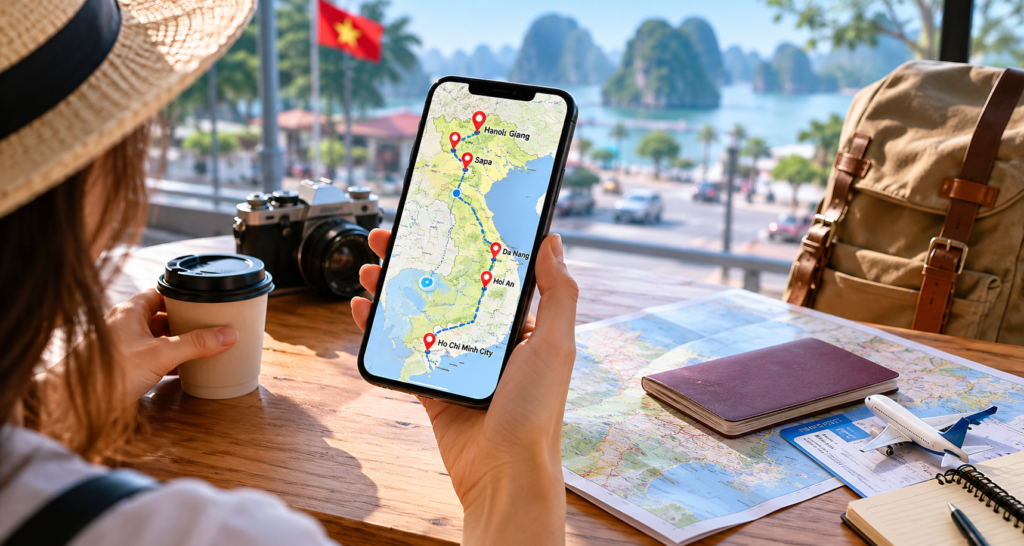
Viettel eSIM is a practical choice for multi-province Vietnam trips because route coverage matters more when travelers move beyond major cities.
A short city break in Hanoi, Ho Chi Minh City, or Da Nang is usually easy for mobile data. A longer Vietnam route is different. Travelers may pass through airports, highways, mountain roads, countryside homestays, island areas, train stations, sleeper buses, and small towns in one trip.
For this kind of itinerary, mobile data is not only for browsing. It helps with maps, Grab, hotel contact, driver messages, WhatsApp, translation, flight updates, and travel support. This guide explains when a Viettel eSIM makes sense for a multi-province Vietnam trip, when another plan may fit better, and what to check before you choose.
Why multi-province Vietnam trips need better eSIM planning
Multi-province Vietnam trips need better eSIM planning because signal quality can change between city centers, highways, valleys, islands, and rural areas.
In large tourist cities, several Vietnam mobile networks can work well for normal travel use. The difference becomes more important when your trip includes mountain passes, long transfer days, rural hotels, boat routes, or national parks where Wi-Fi is not always reliable.
For example, a traveler staying only in Hanoi and Da Nang may mainly care about price and data allowance. A traveler visiting Hanoi, Ha Giang, Sapa, Ninh Binh, Hue, Hoi An, and Ho Chi Minh City should think more carefully about route coverage.
This is where a Viettel eSIM for Vietnam becomes useful. It is not the right plan for every traveler, but it is often worth checking first when your itinerary includes several provinces or remote routes.
When Viettel eSIM fits a multi-province Vietnam itinerary
Viettel eSIM fits travelers who need more consistent mobile data across changing routes rather than only inside one major city.
For a simple city-only trip, a general Vietnam eSIM may be enough. For route-heavy travel, Viettel is usually more relevant because travelers care about staying connected across different provinces, not just getting fast data in one central location.
Viettel eSIM is especially suitable if your trip includes:
- Ha Giang, Sapa, Cao Bang, Mu Cang Chai, or other mountain routes.
- Several provinces in one itinerary.
- Long transfers by bus, train, private car, or motorbike.
- Homestays, rural hotels, or accommodation outside city centers.
- Island, countryside, or national park travel.
- Daily use of maps, Grab, messaging apps, translation, and travel support.
Example Vietnam routes where Viettel eSIM makes sense
Viettel eSIM is most useful on Vietnam routes where travelers move through different terrain and cannot rely only on hotel Wi-Fi.

Hanoi, Ha Giang, Sapa, and Ninh Binh
This northern Vietnam route is one of the clearest cases where network choice can affect the travel experience.
Hanoi is easy for mobile data, but Ha Giang and Sapa include mountain roads, valleys, smaller towns, and homestays outside central areas. Travelers often need data for maps, weather checks, driver contact, accommodation messages, and emergency support.
If Ha Giang Loop or Sapa countryside is part of your trip, Viettel eSIM is usually a sensible option to consider before cheaper city-focused plans.
Hanoi, Ha Long, Cat Ba, and Ninh Binh
This route is easier than Ha Giang or Sapa, but it still includes transfers, coastal areas, islands, and countryside day trips.
A general Vietnam eSIM can be enough for many travelers here. Viettel becomes more useful if you want one data-focused option across the full route, especially for Cat Ba, boat connections, private transfers, or accommodation away from central streets.
Da Nang, Hoi An, Hue, and Phong Nha
Central Vietnam routes often combine city travel, beaches, heritage towns, countryside, caves, and long road transfers.
Da Nang and Hoi An are usually straightforward for tourist connectivity. The route to Hue or Phong Nha can make mobile data more important, especially when checking transport updates, contacting drivers, or staying near cave and countryside areas.
Ho Chi Minh City, Mekong Delta, and Phu Quoc
Southern Vietnam trips may include city streets, rural canals, ferry routes, island beaches, and less central accommodation.
For Ho Chi Minh City only, many Vietnam eSIM plans can work well. For Mekong Delta provinces or moving around quieter parts of Phu Quoc, Viettel eSIM can be a safer choice for travelers who prioritize coverage over having a local phone number.
What Viettel eSIM can and cannot do
Viettel travel eSIM is mainly for mobile data, so it should not be treated as a Vietnamese phone-number plan.
This distinction is important because not all Vietnam eSIMs include the same features. Some plans are data-only. Other selected plans may include a Vietnamese number, incoming calls, or SMS depending on the product.
Viettel travel eSIM is useful for:
- Google Maps and Apple Maps.
- Grab, hotel contact, airline apps, and booking apps.
- WhatsApp, Messenger, Telegram, Line, and email.
- Translation apps, browsing, and travel research.
- Hotspot use if supported by the plan and device settings.
Viettel travel eSIM is not suitable if you need:
- A Vietnamese phone number.
- Incoming local calls.
- SMS receiving or sending.
- Zalo SMS verification.
- Guaranteed banking OTP support.
If your trip requires a local number, choose a Vietnam eSIM with phone number instead. For banking OTPs, travelers should check directly with their own bank because each bank has its own verification rules.
Who should not choose Viettel eSIM for this trip?
Viettel eSIM is not the best choice for travelers whose main need is a Vietnamese number, SMS, local calls, or app verification.
If you only stay in large cities and mainly use hotel Wi-Fi, cafe Wi-Fi, and light mobile data, a general Vietnam eSIM may be enough. If you need Zalo verification, local contact, incoming calls, or SMS, a with-number eSIM is a better fit than a data-only Viettel travel eSIM.
This is why the right question is not simply “Which eSIM is best?” The better question is “Which eSIM fits my route and my real travel needs?”
Viettel eSIM vs general Vietnam eSIM for multi-province trips
The better eSIM choice depends on your Vietnam route, phone-number needs, and how much you rely on mobile data while moving.
| Traveler situation | Better fit | Why it fits |
|---|---|---|
| Staying mainly in Hanoi, Ho Chi Minh City, or Da Nang | General Vietnam eSIM | City coverage is usually easier for normal browsing, maps, and messaging. |
| Ha Giang, Sapa, Cao Bang, or mountain routes | Viettel eSIM | Coverage matters more in mountain and rural travel areas. |
| Several provinces in one trip | Viettel eSIM | A coverage-focused plan is more practical for route-heavy travel. |
| Need Vietnamese number, SMS, or incoming calls | eSIM with phone number | Data-only Viettel eSIM does not include local number features. |
| Need heavy video calls, uploads, or streaming | High-data Vietnam eSIM plan | Daily data allowance may matter more than network choice alone. |
For many travelers, Viettel is not about choosing the cheapest plan. It is about reducing the chance of connection problems during long routes, remote stops, and transfer days.
How to choose the right duration for a multi-province trip
The right eSIM duration should cover your arrival day, transfer days, full travel route, and final airport day.
Do not choose duration only by counting hotel nights. Many travelers need data immediately after landing and again before departure for airport transfer, flight updates, online check-in, and messaging.
As a simple planning guide:
- Choose a short-duration plan for one region or a short city-plus-day-trip route.
- Choose a mid-duration plan for classic north-to-central or south-to-central itineraries.
- Choose a longer plan for slow travel, full-country routes, or flexible travel dates.
If your route is close to the end of a plan validity period, choosing a longer option is usually safer than losing data during a transfer day.
Setup tips before traveling across Vietnam
Installing your eSIM before departure is usually easier than solving setup issues after landing in Vietnam.
Before buying, check that your phone supports eSIM and is carrier-unlocked. A carrier-locked phone may not work with a Vietnam travel eSIM. If your phone is locked, you normally need to contact the original carrier before travel.
After receiving your QR code, install the eSIM while you still have stable Wi-Fi. When you arrive in Vietnam, select the eSIM as your mobile data line and enable data roaming if the setup instructions require it.
The eSIM only works within Vietnam coverage, so it may install before departure but will not provide mobile data until it connects to a supported network in Vietnam.
If you see signal but no internet, common causes include the wrong mobile data line, data roaming turned off, APN settings not saved correctly, or the phone needing a restart after network registration. For step-by-step instructions, read the Vietnam eSIM setup guide.
Common mistakes on multi-province Vietnam trips
Most eSIM problems during multi-province trips come from choosing the wrong plan type or changing phone settings after installation.
Choosing data-only when you need a phone number
A Viettel travel eSIM is not the right plan if your main need is a Vietnamese number, SMS, local calls, or Zalo verification.
Deleting the eSIM after installation
Most travel eSIM QR codes are single-use. If your QR says already used, first check whether the eSIM is already installed in your phone settings. Do not delete an installed eSIM unless support specifically tells you to do so.
Expecting perfect signal everywhere
No mobile network can guarantee perfect signal in every mountain road, basement, hotel room, island corner, or remote valley.
Coverage can depend on terrain, distance from towers, buildings, local congestion, weather, device model, and phone settings.
Waiting until arrival to compare plans
Airport SIM counters can be convenient, but travelers may face queues, limited plan choices, or setup pressure after a long flight.
Choosing online before departure gives you more time to match the eSIM to your real route, especially if your trip includes several provinces.
If your eSIM is installed but not working as expected, use the Vietnam eSIM troubleshooting guide before deleting anything from your phone.
Who should choose Viettel eSIM for a Vietnam trip?
Viettel eSIM is best suited for travelers who value route coverage more than having a local Vietnamese phone number.
Choose Viettel eSIM if your trip includes Ha Giang, Sapa, mountain areas, rural provinces, islands, long transfers, or several regions in one itinerary. It is also a strong fit if your main needs are maps, messaging apps, browsing, translation, email, and hotspot use.
Choose another Vietnam eSIM option if you mainly stay in big cities, need a Vietnamese number, or care more about calls and SMS than wider route coverage.
For multi-province travelers, the best approach is to decide based on route first, then data needs, then phone number needs. If your itinerary includes mountains, rural areas, islands, or long transfers, Viettel eSIM is usually worth checking before choosing a city-focused plan.
FAQ about Viettel eSIM for multi-province Vietnam trips
Is Viettel eSIM good for traveling across several provinces in Vietnam?
Yes, Viettel eSIM is a strong fit for multi-province Vietnam trips where route coverage matters across different travel areas.
It is especially useful when your itinerary includes mountains, countryside roads, islands, or long transfers between cities.
Does Viettel eSIM include a Vietnamese phone number?
No, Viettel travel eSIM should be treated as a data-only eSIM unless a specific product clearly states otherwise.
It does not include a Vietnamese phone number, local calls, SMS, or Zalo SMS verification.
Can I use Viettel eSIM for Ha Giang and Sapa?
Yes, Viettel eSIM is often a practical choice for Ha Giang, Sapa, and northern mountain routes.
Coverage still depends on exact location, terrain, device, and local network conditions, so no provider should claim perfect signal everywhere.
Can I install Viettel eSIM before arriving in Vietnam?
Yes, travelers can usually install the eSIM before departure using Wi-Fi and use it after arriving in Vietnam.
Before installation, make sure your phone supports eSIM and is carrier-unlocked. After installation, avoid deleting the eSIM unless support tells you to do so.
Is Viettel eSIM better than MobiFone or VinaPhone for every traveler?
No, Viettel eSIM is not automatically better for every traveler because the right choice depends on route and feature needs.
Viettel is usually more suitable for coverage-focused routes, while selected MobiFone or VinaPhone plans may be better when you need a Vietnamese phone number, incoming calls, or SMS.
Can I use hotspot with Viettel eSIM?
Yes, hotspot may be supported if the selected Viettel eSIM plan and your phone settings allow it.
Hotspot performance can depend on signal strength, device model, daily data allowance, and the number of connected devices.
What should I do if Viettel eSIM has signal but no internet?
If Viettel eSIM has signal but no internet, check the mobile data line, data roaming, APN settings, and restart the phone.
Do not delete the eSIM immediately. If the issue continues, contact GoVnSIM support with screenshots of your eSIM settings and network status.